
Led by Ola Electric, which registered an industry record of 53,186 vehicles in March, electric two-wheeler (e2W) penetration hit a record at 8.91 per cent - the highest ever for a month (based on Vahan data).
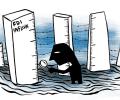
Despite all the noise around India's chance to leverage the China-plus one strategy, India's share of global foreign direct investment (FDI) inflows fell from 3.5 per cent in the first nine months of 2022 to 2.19 per cent in the same period in 2023, according to OECD data. The sharp drop of 54 per cent is much steeper than the overall global FDI inflow decline of 26 per cent in the first nine months. FDI inflows to China have fallen dramatically from a share of 12.5 per cent in the first nine months of 2022 to only 1.7 per cent in the same period in 2023.

If Tesla comes in, India's position as a manufacturing hub will rise many notches, as it will become only the second country, after China, to have both Apple as well as Tesla.

The stock of the country's largest passenger vehicle maker, Maruti Suzuki India (MSIL), has been hitting successive all-time highs over the past three trading sessions. The rally in the scrip has helped it notch over a 21 per cent gain since the start of February, outperforming the National Stock Exchange Nifty Auto Index. The gains for the leader of small passenger cars have been more recent, as the company still trails the Nifty Auto over one- and two-year periods.

After a tentative start, quick commerce (q-commerce) is ablaze, with Blinkit and Zepto slugging it out in a market distinct from other competitors. The latest entrant is Flipkart, which is ramping up its infrastructure in around 12 cities where it will launch the service in the next six to eight weeks, taking on existing players such as Blinkit, Zepto, Instamart, and BigBasket, among others. According to data analysed from Sensor Tower by BofA Global Research, the daily active user (DAU) base of Blinkit has grown by 58 per cent between February 2023 and February 2024.

Traction for its specialty portfolio, a strong showing in the domestic market, and better regulatory compliance are positives for the country's largest pharmaceutical (pharma) company, Sun Pharmaceutical Industries. Given the triggers, some brokerages have increased their earnings per share estimates and target price for 2024-25 (FY25). This should sustain the momentum for the stock, which has been one of the major pharma gainers in 2023-24 (FY24), rising 57 per cent. It is currently trading at Rs 1,547 per share.

Apprentices get at an average of Rs 10,000 to Rs 12,000 per month which can double after one year of on-the-job training.
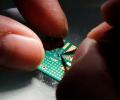
The exclusive club that dominates the global semiconductor fab scenario is about to get a new member. Taiwan, South Korea, and China control nearly 70 per cent of the global capacity. SEMI, the global industry body for semiconductor and electronics design and manufacturing, projects all fabs collectively will churn out 30 million wafers a month this year.

The new scheme, promoting manufacturing of electric vehicles (EVs) by global majors, will give a fillip to companies like Tesla and its upstart rival Vinfast, both of whom have lobbied for lower import duties from the Centre. While Vinfast has already announced an investment of Rs 4,000 crore to set up an electric vehicle (EV) plant in Tamil Nadu, Tesla's next move will be watched carefully. Four years ago, Musk announced that his company would come to India.


India is all set to make its presence felt in the $47 billion global outsourced semiconductor testing and packaging market, an arena where Malaysia and Vietnam have been way ahead so far. The Cabinet last Thursday cleared two projects, the Tata's assembly testing and packaging plant (ATMP) and the Murugappa-owned CG Power with Renesas from Japan as its tech partner. These, together with Micron's assembly and testing plant which is already being constructed in Sanad in Gujarat, will collectively invest Rs 47,300 crore to set up the factories.
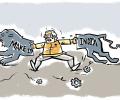
The Department for Promotion of Industry and Internal Trade (DPIIT) has proposed to raise the minimum local content under public procurement order in government contracts. But several local suppliers and multinational companies (MNCs) are saying such a steep target is not attainable. Class-I suppliers, whose goods, services or works offered for procurement has local content equal to or more than 50 per cent may see it hiked to 70 per cent, while it may go up to 50 per cent from 20 per cent for Class-II suppliers.

At $16.8 million per match, the IPL is only behind America's National Football League.

From its lows this month, the stock of Sona BLW Precision Forgings is up 10 per cent on better-than-expected results. The stock rose by 4 per cent in the trading session on Tuesday after Japan's Nikkei Group said the Indian automotive component major has topped its rankings in terms of competitive advantage. The rankings are based on sales, profit margin, capital expenditure, research and development, and market capitalisation.

Can the launch of smartphones under its own brand name by Finnish company HMD Global - despite having a licence to use the Nokia brand which it bought from Microsoft - help it regain its once dominant position in the mobile phone sweepstakes in India, where it was once routed? In 2009, Nokia was the country's largest MNC with revenues of $4 billion and a market share touching 80 per cent in 2010. After this, its fortunes fell. Although it had been the first global player to set up an assembly plant, not only to assemble phones for the local market but for exports, it had to shut down operations in 2014.

Berger Paints, the country's second-largest decorative paint maker, continued to outperform its peers and gain market share in the 2023-24 (FY24) October-December quarter (third quarter, or Q3). The company posted a consolidated revenue growth of 7 per cent compared to the year-ago quarter, surpassing Asian Paints (5.4 per cent) and Kansai Nerolac Paints (5.7 per cent).
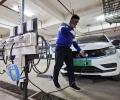
Even as the government debates whether to continue the FAME-II subsidy for electric vehicles (EVs), the share of such vehicles in overall sales is decelerating, after witnessing a heady growth in the first few years. The penetration of EVs - electric two-wheelers, passenger vehicles, three- wheelers and other segments collectively - in the first 10 months of FY24 has been pegged at 4.3 per cent, compared to 3.7 per cent in FY23, according to credit rating agency ICRA.

The Street's optimism on India's largest listed automotive maker by market capitalisation is not misplaced, given the robust wholesale performance in recent months and the strong 2023-24 (FY24) October-December (Q3) results.
In a big push to the production-linked incentive (PLI) scheme, the government has nearly doubled (increase of 81 per cent) the allocation in five key industry segments from Rs 8,405 crore in the Revised Estimate of FY24 to Rs 15,198 crore in the Interim Budget for FY25. The segments cover over eight PLI schemes, including mobile phones, IT hardware, pharma (PLIs for medical devices, intermediates and pharmaceuticals), food processing, telecom hardware and, auto and auto components. In FY24, DPIIT officials, however, said that the disbursements would be much higher at around Rs 11,000 crore than what has been budgeted for the year.

Bajaj Auto, the king of the market for CNG-powered passenger three-wheelers, now wants to replicate this dominance in two-wheelers. The difference is that while the former is zooming - registrations for CNG-powered passenger three-wheelers nearly doubled during January-December 2023 - the latter, meaning a market for CNG-powered two-wheelers, does not exist.
 © 2025 Rediff.com - Investor Information - Advertise with us - Disclaimer - Privacy Policy - Sitemap - Feedback - About us - Terms of use - Grievances